Thaat & Ragas for Beginners
Master the 10 fundamental Indian classical parent scales, understand Bhatkhande notation symbols, and optimize your daily riyaz timing.
Complete Bhatkhande Guide
Master the 10 fundamental Indian classical parent scales, understand Bhatkhande notation symbols, and optimize your daily riyaz timing.
In Hindustani classical music, the parent scales from which all melodies originate are called **Thaats**. Compiled systematically by musicologist Pandit Vishnu Narayan Bhatkhande, this framework organizes classical structures into 10 fundamental scales. Mastering these thaats, reading **Bhatkhande notation symbols** (*Achal* and *Vikrit Swars*), and matching your scale practice with natural **Riyaz daily intervals** will elevate your musicality on both physical harmoniums and Web Harmonium.
Every raga belongs to one of the 10 Parent Thaats. Start by practicing the natural white-key scale (Bilawal Thaat) to solidify finger transitions before attempting the komal (flat) and teevra (sharp) pitch configurations.
Hindustani classical music relies on the Bhatkhande notation system. Swars are divided into two primary categories: **Achal Swars** (immovable notes) and **Vikrit Swars** (movable notes that can be flat or sharp).
| Swar Classification | Notation Symbol | Keyboard Action / Key Configuration |
|---|---|---|
| Achal Swar (Immovable) | S and P (Sa / Pa) | Always natural; no flats or sharps. Natural white keys. |
| Shuddha Swar (Natural) | R G M D N | No marking. Natural white keys. |
| Komal Swar (Flat) | Underline: R G D N | Pitch shifted down by a half-step. Black key immediately left. |
| Teevra Swar (Sharp) | Vertical Tick above: Ḿ (Teevra Ma) | Pitch shifted up by a half-step. Black key immediately right. |
| Mandra Saptak (Lower Octave) | Dot below: Ṣ Ṛ G̣ | Play in the octave to the left of middle Sa. |
| Taar Saptak (Higher Octave) | Dot above: Ṡ Ṙ Ġ | Play in the octave to the right of middle Sa. |
Practicing the 10 thaats trains your ears to hear intervals accurately. Here are the detailed notation rules, Aaroh (ascent), Avaroh (descent), and Pakad (signature phrase) for the 5 most popular thaats, complete with keyboard layout maps.
Western Counterpart: C Major Scale.
Aaroh: S - R - G - M - P - D - N - Ṡ
Avaroh: Ṡ - N - D - P - M - G - R - S
Pakad: G - R - G - P - M - G - R - S
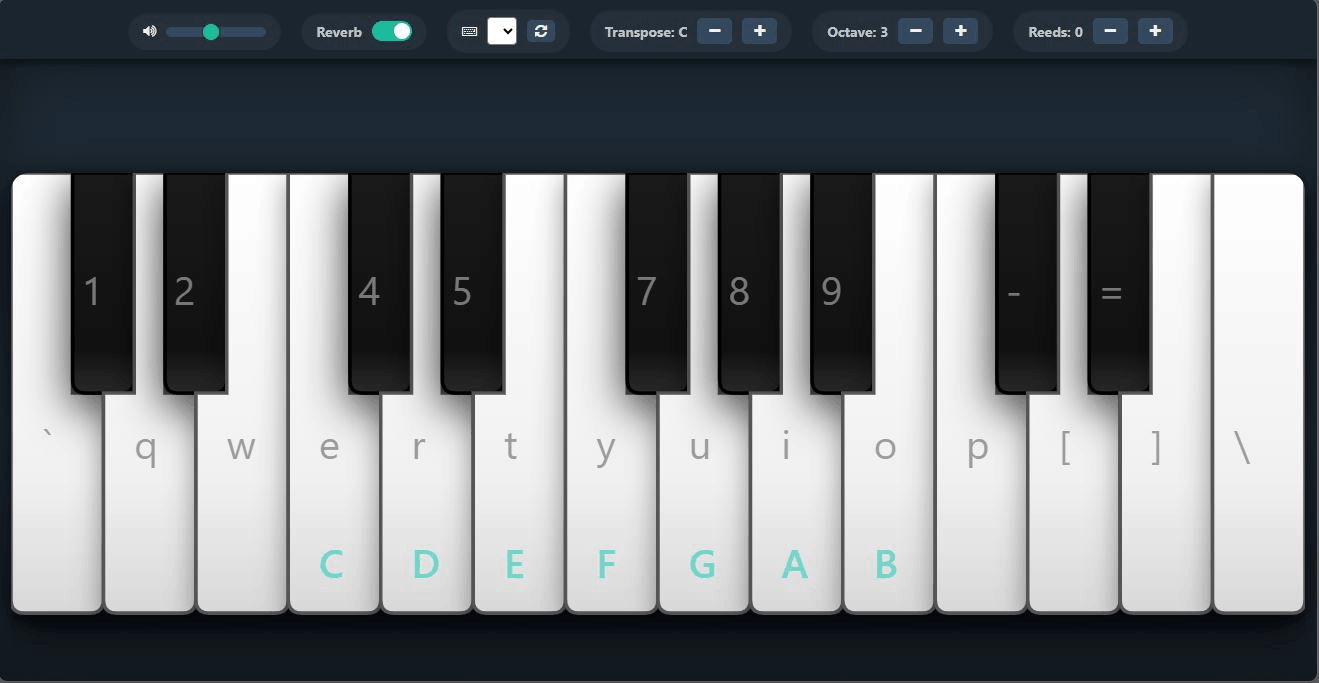
Keyboard Map: Play all consecutive white keys starting on C.
Western Counterpart: Lydian Mode.
Aaroh: S - R - G - Ḿ - P - D - N - Ṡ
Avaroh: Ṡ - N - D - P - Ḿ - G - R - S
Pakad: Ṇ - R - G - Ḿ - G - R - S
Keyboard Map: Replace the natural F white key with the F# black key (third black key in the three-black-key group).
Western Counterpart: Mixolydian Mode.
Aaroh: S - R - G - M - P - D - Ṅ (Note: Ni is often omitted in ascent: S-G-M-P-D-Ṡ)
Avaroh: Ṡ - N - D - P - M - G - R - S
Pakad: G - M - P - D - N - D - P - M - G
Keyboard Map: Play all white keys, but replace the B natural key with the Bb black key (the rightmost black key in the three-black-key cluster) during descent.
Western Counterpart: Double Harmonic Major Scale.
Aaroh: S - R - G - M - P - D - N - Ṡ
Avaroh: Ṡ - N - D - P - M - G - R - S
Pakad: G - M - D - D - P - M - G - R - R - S (Note: Shake Komal Re and Dha with a gentle vibrato/andolan)
Keyboard Map: Use Db black key (first black key in the two-black-key group) and Ab black key (second black key in the three-black-key group).
Western Counterpart: Dorian Mode.
Aaroh: S - R - G - M - P - D - N - Ṡ
Avaroh: Ṡ - N - D - P - M - G - R - S
Pakad: S - R - R - G - G - M - M - P
Keyboard Map: Replace E natural with Eb black key, and replace B natural with Bb black key.
Hindustani music has a scientific **Time Theory of Ragas** (*Samay*). Ragas are performed during specific three-hour intervals (*Prahars*) of the day to align with the changing natural light, temperature, and human bio-rhythms. Practicing scales during their traditional hours accelerates your tuning accuracy and emotional depth:
| Time Interval (Prahar) | Optimal Hours | Dominant Thaat Scales | Practice Ragas | Biological / Aesthetic Mood |
|---|---|---|---|---|
| Dawn (Pratah-Kaal) | 4:00 AM – 7:00 AM | Bhairav, Bhairavi | Raga Bhairav | Devotional, calm, meditative, deeply spiritual. |
| Late Morning | 7:00 AM – 10:00 AM | Bilawal, Todi | Raga Bilawal, Todi | Fresh energy, awakening, structured discipline. |
| Mid-Day | 10:00 AM – 4:00 PM | Asavari, Sarang | Raga Shuddha Sarang | Introspective, serious, warming sun. |
| Dusk (Sandhi-Prakash) | 4:00 PM – 7:00 PM | Poorvi, Marwa | Raga Shree, Marwa | Melancholy, transition, threshold between light/dark. |
| Evening (Ratri-Kaal) | 7:00 PM – 10:00 PM | Kalyan, Khamaj | Raga Yaman, Khamaj | Romantic, peaceful, meditative relaxation. |
| Night / Midnight | 10:00 PM – 4:00 AM | Kafi, Bhairavi | Raga Darbari, Kafi | Deep emotional passion, mystery, vast dark space. |
Sing and hold middle C (Sa) continuously to match your vocal frequency. Connect Web Harmonium's drone reed to Sa to maintain a reference foundation.
Identify if any notes are omitted in the raga. For example, Raga Bhupali omits Ma and Ni completely (Pentatonic scale: S-R-G-P-D-S').
Ascend and descend slowly. Ensure each note transition uses our recommended finger placement legato guidelines to prevent silent gaps.
Repeat the pakad phrase until the unique mood of the raga fills the room. The pakad acts as the musical identity of the raga.
Achal Swars are immovable notes. In Indian music, Sa (Tonic) and Pa (Perfect Fifth) are achal swars; they never take flat (komal) or sharp (teevra) forms.
Hindustani music associates ragas with hours of the day because the structural combination of notes mirrors the changing natural elements and the emotional state of the human body.
If Sa is mapped to C, Teevra Ma is mapped to F# (the first black key in the three-black-key cluster). Press it with your index (2) or middle (3) finger depending on the raga pattern.