Last updated: September 2026
The Happy Birthday song needs only six different notes, so it is one of the first "real" melodies every harmonium learner should play. Below you get the complete tune in sargam two ways: Version A keeps the phrase exactly where the song naturally sits (starting from mandra Pa, the fifth below your Sa), and Version B starts on Sa itself for players who have not yet explored the lower octave. Both are correct — pick whichever reads easier for you.
Happy Birthday is three nearly identical phrases plus one closing line. Learn line 1 slowly, and lines 2 and 4 are 80% learned already. A dot before a swar (like .Pa) means the octave below Sa.
Version A — natural position (starts on .Pa)
This is the tune as it is actually shaped: it launches from the fifth below the tonic. The dot prefix (.Pa, .Dha, .Ni) marks the mandra (lower) octave — those keys sit just left of your Sa.
| Lyric line | Sargam |
|---|---|
| Happy birthday to you | .Pa .Pa .Dha .Pa Sa .Ni |
| Happy birthday to you | .Pa .Pa .Dha .Pa Re Sa |
| Happy birthday dear (name) | .Pa .Pa Pa Ga Sa .Ni .Dha |
| Happy birthday to you | Ma Ma Ga Sa Re Sa |
Notice the pattern: lines 1 and 2 differ only in their last two notes, and line 3 makes the big joyful leap (.Pa up to Pa — a full octave). Take that leap slowly the first few times.
Version B — start on Sa (no lower octave needed)
The same melody transposed so the first note is Sa. One flat sneaks in: the last line uses komal ni (written ni, a black key) — a nice gentle introduction to komal swars.
| Lyric line | Sargam |
|---|---|
| Happy birthday to you | Sa Sa Re Sa Ma Ga |
| Happy birthday to you | Sa Sa Re Sa Pa Ma |
| Happy birthday dear (name) | Sa Sa Sa' Dha Ma Ga Re |
| Happy birthday to you | ni ni Dha Ma Pa Ma |
How to play it on Web Harmonium
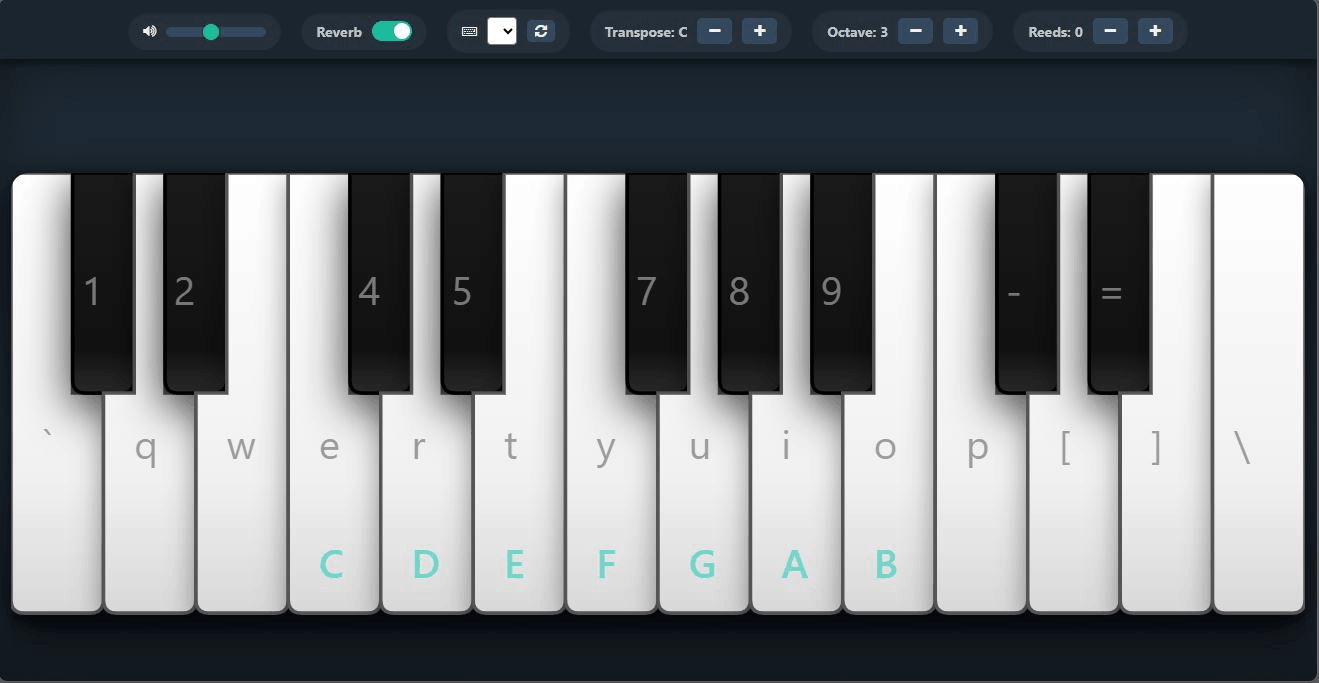
Open Web Harmonium — in the default layout, Sa sits on the E key of your computer keyboard, and the white keys continue rightward (R T Y U I O P…). For Version A, the mandra .Pa .Dha .Ni sit on the keys to the left of E (see the full keyboard map). Sing along as you play; if the pitch feels high or low for the birthday crowd, one click of Transpose fixes everyone's key.
Party trick: add +1 Reed in the Reeds control and a touch of Reverb — the melody instantly sounds like a festive double-reed harmonium filling the room.
Practice it in four steps
- Play line 1 alone until it flows, counting a gentle 3-beat waltz feel (Hap-py | BIRTH-day | to you).
- Add line 2 — only the ending changes.
- Drill the octave leap of line 3 (or the Sa-to-Sa' leap in Version B) five times slowly.
- Join all four lines and sing the name in line 3 — stretch the notes to fit any name length; that rubato is traditional!
Enjoying melody practice? The same skills power our easy songs with sargam collection and the bhajan notes guide.
Frequently asked questions
What are the sargam notes for Happy Birthday?
Starting naturally from the lower fifth: .Pa .Pa .Dha .Pa Sa .Ni / .Pa .Pa .Dha .Pa Re Sa / .Pa .Pa Pa Ga Sa .Ni .Dha / Ma Ma Ga Sa Re Sa. A start-on-Sa alternative is given in the article.
What does the dot before a note like .Pa mean?
The dot marks the mandra saptak — the octave below your Sa. .Pa is the fifth below Sa, physically a few keys to the left of Sa on the keyboard.
Is Happy Birthday easy to play on harmonium?
Yes — it uses only six different notes and three near-identical phrases. Most beginners play it recognisably within one 15-minute session, and confidently within a day or two.
Which keys play Happy Birthday on Web Harmonium?
With the default layout (Sa on the E key), Version B starts right on E: E E R E Y T for the first line. The on-screen key labels and the laptop keyboard map guide show every position.
What scale should I play Happy Birthday in for singing?
Whatever suits the group — that is the harmonium's superpower. Play the same sargam and click Transpose until the crowd sings comfortably; C or D works for most mixed groups.
Does Happy Birthday use any black keys?
Version A uses none — all natural swars. Version B (starting on Sa) needs one: komal ni in the final line, a friendly first encounter with the black keys.