Last updated: September 2026
Harmoniums come in a handful of standard varieties: fixed-body standard models, portable folding models that collapse into their own case, and scale changer models whose entire keyboard slides to transpose. Cutting across those body types, instruments differ by reed banks (single, double, triple), coupler mechanisms, and drone stops. This guide untangles all of it so you can shortlist confidently.
Body type decides portability, reed banks decide the voice, and mechanisms (coupler, scale changer) add convenience. For most learners a standard double-reed harmonium with a coupler is the ideal first instrument.
What are the main body types?
| Type | How it works | Trade-offs |
|---|---|---|
| Standard (fixed) | One-piece cabinet, keys and bellows always ready | Best value and reliability; bulkier to carry |
| Portable / folding | Keyboard and bellows fold down into a suitcase-style box | Travel-friendly; slightly costlier and more moving parts |
| Scale changer | Entire keyboard slides sideways so any key becomes Sa | Instant mechanical transpose; heavy, expensive, more maintenance |
What do single, double, and triple reeds mean?
Each key can open one, two, or three reeds at once, drawn from banks tuned in different octaves — commonly called bass (low), male (middle), and female (high).
| Reed setup | Sound | Best for |
|---|---|---|
| Single reed (male) | Light, clear, quiet | Small rooms, children, tight budgets |
| Double reed (bass + male) | Full, warm, devotional body | Most singers and kirtan groups — the popular choice |
| Triple reed (bass + male + female) | Big, bright, concert presence | Stage performers and professionals |
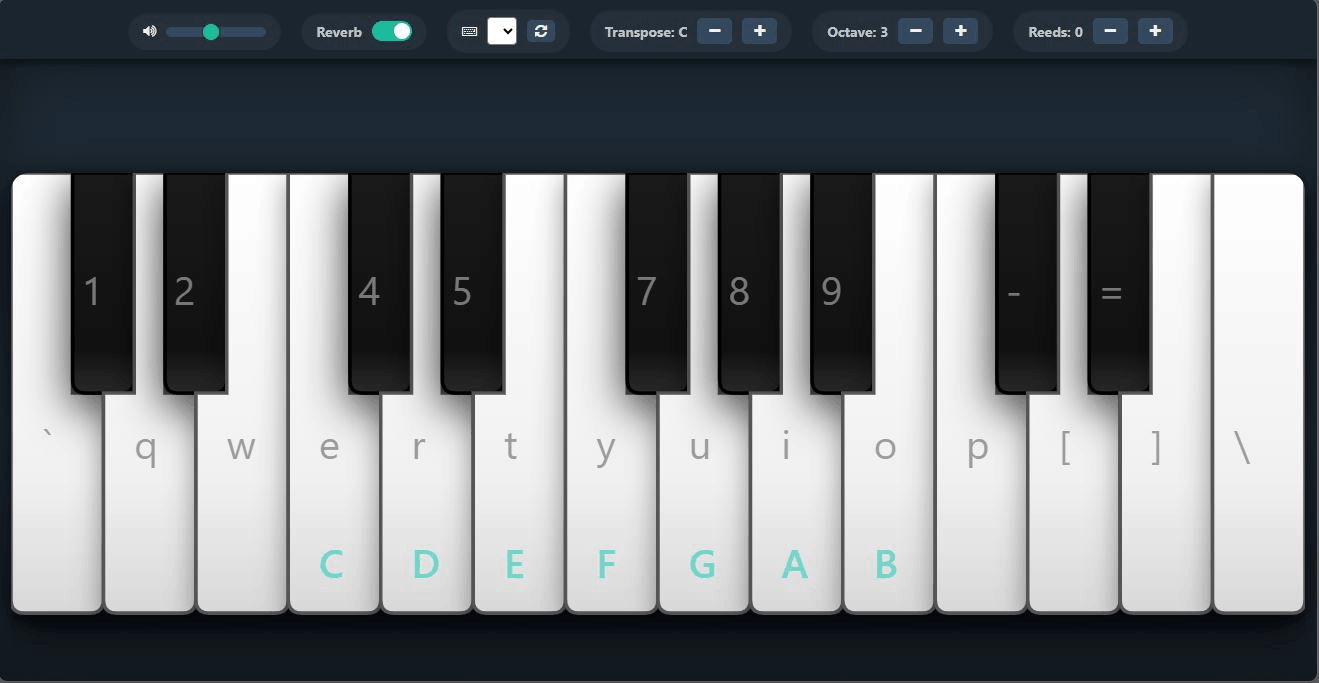
On Web Harmonium, the Reeds control simulates exactly this idea — click + to stack octave reeds and hear the tone thicken in real time.
What does a coupler do?
A coupler mechanically links each key to the same note one octave away, so one finger sounds two notes. Switched on, it fattens melodies instantly — popular in qawwali and kirtan. It is a convenience, not a necessity; you can achieve similar fullness with two-hand octave playing, as taught in our finger technique guide.
What are drone stops for?
Drone stops hold a constant note (usually selectable among a few pitches) underneath your playing — an instant tanpura substitute that anchors your Sa. Singers doing riyaz love them; see accompanying singing with drones for how to use them musically.
Which type should you choose?
| You are… | Choose |
|---|---|
| A beginner learning bhajan and sargam | Standard body, double reed, coupler optional |
| A traveling kirtan leader or yoga teacher | Portable folding, double reed |
| A vocal accompanist playing for many singers | Scale changer (or learn keyboard transposition instead) |
| A stage/qawwali performer | Triple reed with coupler |
| Not sure yet | Practice free on Web Harmonium until your needs are obvious |
Once you know your type, the price & buying guide shows what each tier should cost and how to test an instrument in the shop.
Frequently asked questions
What is a scale changer harmonium?
A harmonium whose whole keyboard physically slides left or right, so the same fingering sounds in a different key. It gives instant transposition for accompanists but adds weight, cost, and mechanical complexity.
Which is better: double reed or triple reed harmonium?
Double reed (bass + male) is warmer, lighter, and cheaper — ideal for singing accompaniment and daily practice. Triple reed adds a bright female bank for stage volume. Most learners are happiest with double reed.
What is a coupler in a harmonium?
A mechanism that links each pressed key to its octave, sounding two notes per finger. It creates a fuller sound instantly, especially with melodies, and can be switched on or off.
Are portable folding harmoniums as good as standard ones?
Good folding models from reputable makers sound close to standard bodies, but the folding mechanism adds joints that can leak air with age. If you rarely travel, a standard body gives more tone per rupee.
How many octaves does a harmonium keyboard cover?
Typically 2.5 to 3.5 octaves (about 30–42 keys). Three octaves comfortably covers mandra, madhya, and taar saptak phrases used in most vocal music.
Can an online harmonium simulate different reed types?
Web Harmonium includes a Reeds control that stacks octave reeds on each note — functionally similar to switching from single to double reed — so you can hear the difference before buying hardware.